Why Web Design and CRO Companies Matter
Why Web Design and CRO Companies Matter for Business Growth Many businesses do not need a prettier website first. They need a website that helps the right visitor understand the offer, trust the company, and take the next step. That is where web design and CRO companies become valuable: they connect how a website looks […]
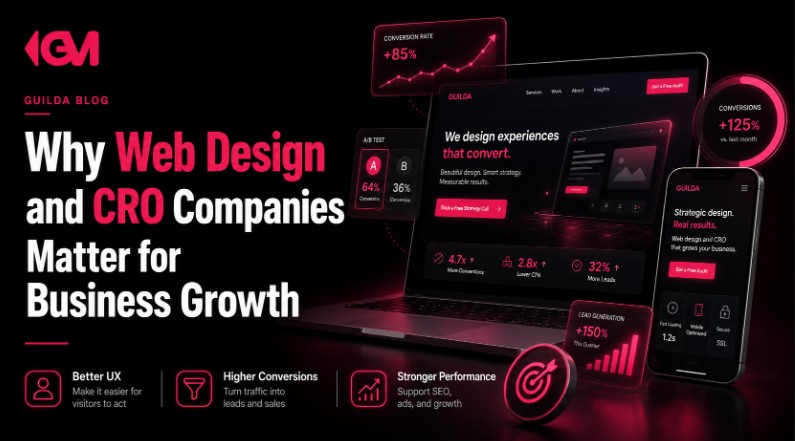
Why Web Design and CRO Companies Matter for Business Growth
Many businesses do not need a prettier website first. They need a website that helps the right visitor understand the offer, trust the company, and take the next step. That is where web design and CRO companies become valuable: they connect how a website looks with how it performs.
A strong website should support visibility, credibility, lead generation, paid traffic, SEO, and sales conversations. If it only looks modern but does not make people call, request a quote, book a consultation, buy, or submit a form, it is not doing enough for the business.
For many U.S. businesses, the real issue is not a lack of marketing activity. The issue is that the website is not converting enough of the attention the business already earns.
What Do Web Design and CRO Companies Actually Do?
Web design shapes the visual structure, user experience, page layout, mobile usability, brand presentation, and clarity of the website. CRO, or conversion rate optimization, studies why visitors hesitate and what can be improved to help more qualified visitors take action.
A good website does not only present your business. It reduces doubt at the exact moment a potential customer is deciding whether to trust you.
The best web design and CRO companies do not treat design and conversion as separate projects. They look at the full path from search intent to page experience to contact form to sales follow-up.
That matters because a visitor rarely becomes a lead because of one isolated element. They convert because the page answers the right questions, presents the offer clearly, builds trust, removes friction, and makes the next step feel safe and obvious.
Why Do Businesses Need Web Design and CRO Companies?
Businesses need web design and CRO companies when their website is getting attention but not producing enough useful action. This can show up as low-quality leads, expensive ad campaigns, weak form submissions, few phone calls, poor mobile engagement, or visitors leaving without understanding why the company is the right choice.
For a local service business, that may mean people find the company on Google Maps, visit the website, compare reviews, then choose a competitor. For a professional services firm, it may mean visitors read the homepage but never feel confident enough to schedule a consultation. For an eCommerce brand, it may mean paid traffic reaches product pages but shoppers abandon the site before checkout.
The real problem is usually not one page
A weak website conversion system can involve several connected problems:
- The offer is not clear within the first few seconds.
- The homepage talks about the company but not the customer’s problem.
- Service pages lack proof, process, location relevance, or decision support.
- Calls to action are vague, hidden, or inconsistent.
- Mobile users have to work too hard to call, book, buy, or request a quote.
- Reviews, testimonials, trust signals, and credentials are not placed near key decision points.
- Paid traffic lands on pages that were never built for campaign intent.
When these issues stack up, the business may assume it needs more traffic. In reality, it may need a clearer conversion path.
Why a Good-Looking Website Can Still Fail
A website can look polished and still underperform. This happens when design choices are made for appearance before strategy. The result is often a site that feels modern but does not help visitors make a decision.
Common examples include large visual sections with little substance, generic headlines, weak service descriptions, unclear pricing context, stock-style imagery, slow-loading pages, and contact forms that ask for too much too soon.
A visitor is not judging design alone
Most visitors are making a business decision. They are asking:
- Do they solve my specific problem?
- Do they serve my location, industry, or situation?
- Can I trust them?
- What happens after I contact them?
- Is this company professional enough for the price or risk involved?
- Is it easier to choose them or go back to Google?
CRO helps identify where the website does not answer those questions clearly enough.
How Web Design and CRO Companies Improve Website Conversion
Strong web design and CRO companies improve conversion by aligning message, structure, trust, usability, and traffic intent. They do not simply change button colors or redesign pages based on taste. They evaluate how visitors move through the website and where qualified prospects lose confidence.
Key areas they usually evaluate
- Positioning: Is it immediately clear who the business helps and why it is different?
- Page hierarchy: Does the most important information appear before the visitor loses interest?
- Trust signals: Are reviews, certifications, guarantees, process details, photos, or proof points used in the right places?
- Mobile experience: Can mobile visitors contact the business without friction?
- Lead quality: Are forms and calls to action attracting the right kind of prospect?
- Landing pages: Do ad campaigns send users to pages that match the promise of the ad?
- Analytics: Is the business measuring calls, form submissions, quote requests, bookings, and meaningful actions?
This work creates a stronger foundation for SEO, paid search, local SEO, Google Business Profile traffic, Meta Ads, email campaigns, and referral traffic.
Weak Redesign vs. Strong Conversion Strategy
| Weak approach | Stronger approach |
|---|---|
| Redesigning because the website feels outdated. | Redesigning based on business goals, visitor intent, lead quality, and conversion bottlenecks. |
| Writing broad copy that could apply to any competitor. | Clarifying the offer, service fit, proof points, process, and decision criteria. |
| Sending all ad traffic to the homepage. | Building landing pages that match campaign intent and reduce unnecessary choices. |
| Adding more calls to action without improving trust. | Placing calls to action after the visitor has enough context to act confidently. |
| Judging success by how the website looks. | Judging success by clarity, usability, qualified leads, conversion paths, and measurable actions. |
A Practical Example: When More Traffic Is Not the Real Fix
Imagine a home services company running Google Ads for emergency repairs. The ads bring visitors to a general homepage with a large hero image, a short description, and a contact button near the bottom of the page.
The campaign may appear to have a traffic problem, but the deeper issue could be the page experience. A customer with an urgent need does not want to search through a generic website. They need fast reassurance: service area, response process, phone number, trust signals, reviews, emergency availability, and a simple way to contact the business.
In that situation, better design alone is not enough. The business needs a conversion-focused landing page that matches the intent of the search. That is where CRO thinking changes the strategy.
Signs You May Need Web Design and CRO Companies
You may not need to rebuild everything. But if several of these signs are present, your website likely needs a conversion review.
- Your website gets traffic, but calls or form submissions are weak.
- Paid ads are getting clicks, but the cost per lead feels too high.
- Visitors ask basic questions that should already be answered on the site.
- Your homepage does not clearly explain who you help, what you do, and what action to take.
- Your service pages are thin, generic, or too similar to each other.
- Your mobile website feels cramped, slow, confusing, or hard to navigate.
- Your website does not reflect the quality, pricing, or professionalism of your business.
- You have reviews, proof, or strong differentiators, but they are not visible near conversion points.
- You are investing in SEO, Google Ads, or Meta Ads without improving landing pages.
What Should Be Fixed Before Spending More on Ads?
Before increasing ad budget, a business should look at the page where the visitor lands. More traffic can expose website problems faster, but it will not automatically solve them.
A simple CRO checklist for business owners
- Can a first-time visitor understand the offer in five seconds?
- Is the primary call to action visible without searching?
- Does the page match the intent of the traffic source?
- Are reviews, proof points, service details, or trust elements close to decision points?
- Is the mobile experience easy for calls, forms, purchases, or bookings?
- Does the form ask only for what is necessary at that stage?
- Are conversions being tracked correctly in analytics, ads platforms, and the CRM?
- Does the follow-up process support the promise made on the website?
If the answer is unclear on several points, more advertising may create more waste instead of more qualified opportunities.
How Web Design, SEO, and CRO Work Together
SEO can help bring qualified visitors to the website. Web design can make the experience easier to navigate. CRO can help turn that attention into meaningful action. When these pieces are disconnected, performance becomes harder to diagnose.
For example, a local business may rank for a valuable service keyword but lose visitors because the service page lacks location relevance, proof, and a clear quote request path. A SaaS company may publish helpful content but fail to guide readers toward demos, comparisons, use cases, or product education. An eCommerce store may get organic traffic to product pages but lose shoppers because product information, trust signals, shipping clarity, or checkout flow creates hesitation.
A better website strategy connects visibility with conversion. It does not treat SEO traffic, paid traffic, website UX, and lead generation as separate lanes.
What Not to Do When Your Website Is Underperforming
When a website is not producing results, many businesses move too quickly into a redesign. That can help, but only if the redesign is based on the right diagnosis.
Avoid these common mistakes
- Do not redesign only because a competitor’s website looks better.
- Do not choose a design direction before clarifying the website’s business goal.
- Do not send every campaign to the homepage by default.
- Do not assume low conversions always mean bad traffic.
- Do not bury the strongest trust signals on a separate page nobody visits.
- Do not make users fill out long forms before they understand the value of contacting you.
- Do not launch a new website without tracking the actions that matter.
The goal is not to make the website more aggressive. The goal is to make the decision easier for the right visitor.
How to Choose the Right Web Design and CRO Partner
The right partner should be able to discuss business goals, traffic sources, conversion paths, user experience, messaging, SEO, paid media, and lead quality. If the conversation is only about colors, animations, and layout preferences, the project may miss the bigger opportunity.
Questions to ask before hiring
- How will you evaluate why the current website is not converting?
- How will you connect design decisions to lead generation or sales goals?
- Will you review traffic sources, SEO pages, ad campaigns, and landing pages?
- How will calls, forms, purchases, bookings, and other conversions be tracked?
- How will the website support mobile visitors?
- How will the copy explain the offer, proof, process, and next step?
A strong partner should help you see the website as part of a growth system, not just a digital brochure.
FAQ About Web Design and CRO Companies
Is CRO only for large companies?
No. CRO can help small and mid-sized businesses because even modest improvements in clarity, trust, forms, mobile usability, and landing page relevance may reduce wasted traffic and support better lead quality.
Do I need a full redesign or just CRO improvements?
It depends on the condition of your current website. Some businesses need a full rebuild because the structure, UX, and messaging are outdated. Others can improve performance by refining key pages, calls to action, forms, page speed, proof points, and landing pages.
Can CRO help with Google Ads performance?
Yes, CRO can support paid traffic performance by improving landing page relevance, trust, message match, and action paths. It does not guarantee lower costs, but it can help reduce friction after the click.
How does CRO affect lead quality?
CRO can improve lead quality by making the offer clearer, setting better expectations, qualifying visitors through page content, and guiding the right prospects toward the right action.
Before You Invest More, Find the Real Bottleneck
A website should not make growth harder. It should help qualified visitors understand the business, trust the offer, and move forward with less hesitation.
If your business is investing in SEO, local SEO, Google Ads, Meta Ads, content, or referrals, your website needs to support that investment. Otherwise, you may keep paying to bring people into a conversion path that is not clear enough to perform.
Guilda Marketing helps businesses build stronger digital presence, clearer websites, and more strategic conversion systems. If you want to understand where your website is losing opportunities, you can talk to Guilda Marketing and get a clearer direction before investing more into traffic.
Want to apply this to your business?
Tell us about your business and we will review your digital presence, growth stage and the biggest opportunities for your next marketing move.