Better Marketing Funnels Beat More Traffic
Better Marketing Funnels: Why More Traffic Is Not Always the Answer Most businesses asking for more traffic actually need better marketing funnels. More visitors can help, but only if the website, offer, trust signals, landing pages, follow-up process, and sales path are strong enough to turn that attention into qualified leads or sales. When a […]
Better Marketing Funnels: Why More Traffic Is Not Always the Answer
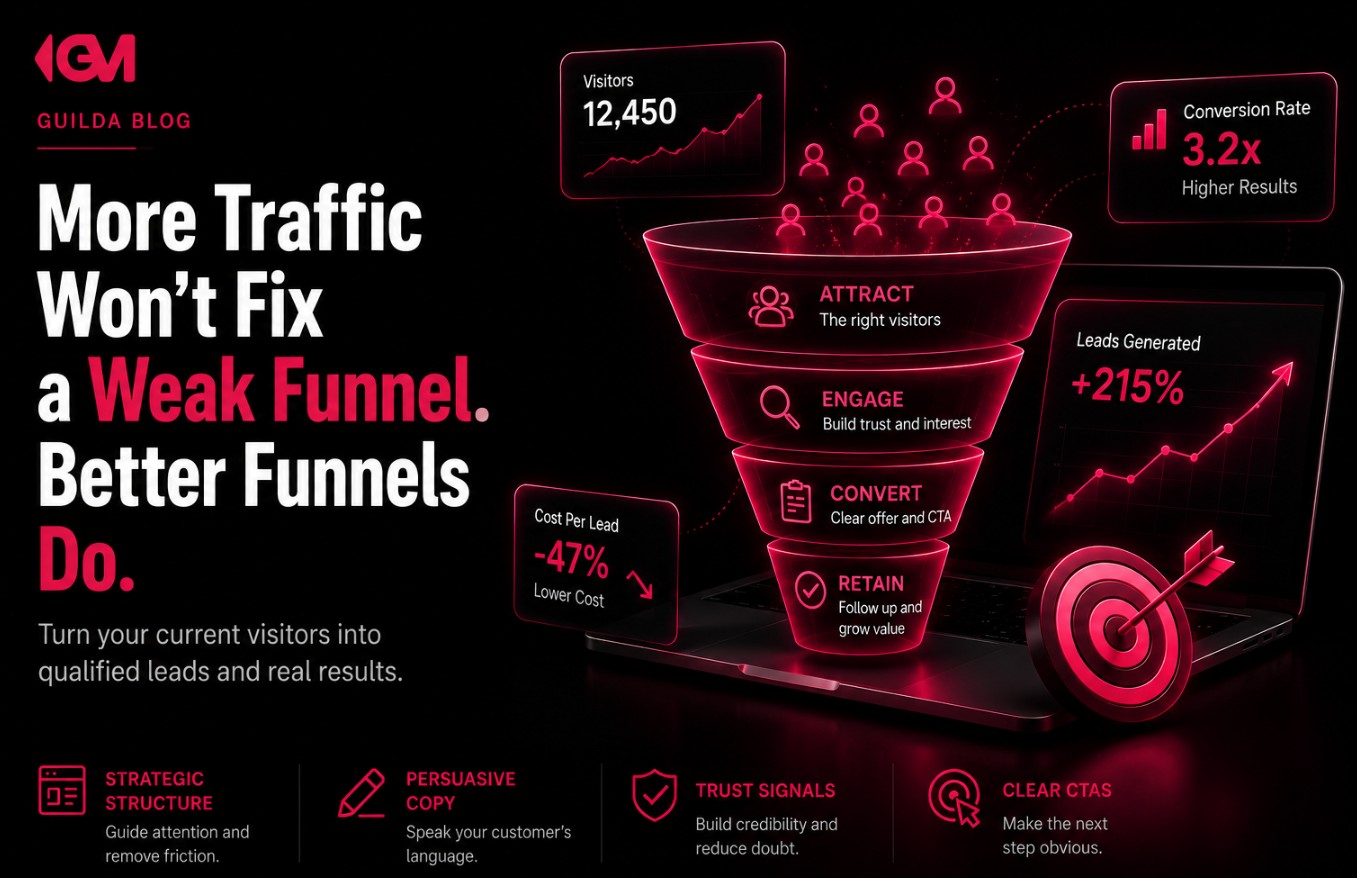
Most businesses asking for more traffic actually need better marketing funnels. More visitors can help, but only if the website, offer, trust signals, landing pages, follow-up process, and sales path are strong enough to turn that attention into qualified leads or sales.
When a business invests in SEO, Google Ads, Meta Ads, or local visibility before fixing conversion problems, it often pays to send more people into a system that is already leaking opportunities. The issue is not always demand. Many times, the issue is what happens after someone clicks.
More traffic does not fix a weak funnel. It usually exposes it faster.
For a local service company, that leak may be a confusing service page. For an eCommerce brand, it may be a product page that does not answer buyer objections. For a SaaS company, it may be unclear positioning. For a healthcare or wellness practice, it may be a website that does not build enough trust before asking for a call.
Why Better Marketing Funnels Matter Before More Traffic
A marketing funnel is the path someone follows from first discovering your business to taking a meaningful action, such as calling, requesting a quote, booking a consultation, starting a trial, or completing a purchase.
A strong funnel does not manipulate people. It removes friction. It helps the right visitor understand what you offer, why it matters, whether they can trust you, and what they should do next.
This matters because many businesses already have some level of visibility. They may be getting clicks from Google, impressions from social media, visits from paid ads, referrals from existing customers, or traffic from a Google Business Profile. But visibility alone is not the same as opportunity.
- A visitor can land on your website and leave because the offer is unclear.
- A shopper can view a product and abandon it because the page does not build confidence.
- A homeowner can compare three contractors and choose the one with stronger reviews, clearer service pages, and easier quote requests.
- A SaaS buyer can understand the feature list but still not understand why your product is the best fit.
Better marketing funnels help turn existing attention into measurable business outcomes. That is why funnel quality should be evaluated before increasing ad spend or chasing higher traffic numbers.
The Real Bottleneck Is Usually After the Click
When leads are slow, many business owners assume the top of the funnel is the problem. They ask for more keywords, more ad campaigns, more posts, more clicks, or more impressions.
Sometimes that is true. A business with almost no visibility may need SEO, local SEO, content strategy, or paid traffic. But if people are already visiting the website and not converting, the smarter question is different:
Where are interested visitors hesitating, losing trust, or failing to see the next step?
That question reveals the real conversion problems. The page may not explain the service clearly. The call to action may be weak. The form may ask for too much. The mobile experience may be slow. The proof may be buried. The follow-up may be inconsistent. The offer may sound like every competitor in the market.
A practical U.S. business example
Picture an HVAC company running Google Ads in a competitive metro area. The ads bring people searching for emergency repair, AC installation, or seasonal maintenance. The traffic is valuable because the intent is already strong.
But if the landing page looks generic, loads slowly on mobile, hides the phone number, does not show reviews, and gives the same message as every other contractor, more ad spend may only increase waste. The better move is to improve the funnel first: clearer service messaging, stronger trust signals, faster quote paths, better mobile usability, and a follow-up process that does not let leads sit unanswered.
The company may still need traffic. But it needs a stronger path from click to call before traffic becomes profitable.
Weak Funnel vs. Strong Funnel: What Changes?
A weak funnel usually makes the visitor work too hard. A stronger funnel makes the decision easier without pressuring the visitor or overpromising results.
| Funnel Area | Weak Approach | Stronger Approach |
|---|---|---|
| Homepage | General claims with no clear next step | Clear positioning, primary services, trust indicators, and simple conversion paths |
| Landing pages | Built only around keywords or ad groups | Built around search intent, objections, proof, and action |
| Calls to action | Vague buttons like Learn More or Submit | Specific actions such as Request a Quote, Book a Consultation, or Get a Website Review |
| Trust signals | Reviews, credentials, and proof hidden low on the page | Relevant proof placed near decision points |
| Follow-up | Leads handled manually with no clear process | CRM, response expectations, lead qualification, and timely follow-up |
The stronger approach does not require gimmicks. It requires alignment. The message, page structure, proof, offer, and next step should all support the same decision.
Warning Signs You Need Better Marketing Funnels, Not More Traffic
Before increasing your marketing budget, look for signs that your existing traffic is not being used well. These issues often show up across websites, landing pages, local SEO campaigns, paid search, and lead generation systems.
- Your website gets visits, but few calls, form submissions, bookings, or purchases.
- Paid ads generate clicks, but the cost per qualified lead feels too high.
- Your Google Business Profile gets views, but customers still choose competitors with stronger reviews or clearer websites.
- Visitors land on service pages but do not move to a contact form or phone call.
- Your landing pages explain what you do, but not why someone should choose you.
- Your forms ask for too much information before the visitor trusts the business.
- Your sales team says leads are low quality, but the website does not qualify visitors clearly.
- Your follow-up process depends on whoever sees the email first.
- Mobile users have to pinch, scroll, wait, or search for contact options.
If several of these are true, more traffic may help less than expected. Funnel improvement should come first because it can make every existing channel work harder.
How Better Marketing Funnels Improve Different Business Models
The right funnel depends on the business model. A local contractor, an eCommerce store, a professional service firm, and a SaaS company should not use the same conversion path.
For local and service-area businesses
Local businesses often depend on Google Maps, local SEO, service pages, reviews, and fast contact options. The funnel should reduce doubt quickly because customers are usually comparing several providers at once.
A stronger local funnel may include clear service-area information, visible phone numbers, review highlights, project photos when appropriate, emergency or same-week availability details, and service pages that match how people actually search.
For businesses that rely on calls and quote requests, a structured service business lead generation strategy can help connect visibility, website conversion, and follow-up into one measurable system.
For eCommerce brands
An eCommerce funnel is often won or lost on product pages, category pages, cart experience, shipping clarity, return expectations, reviews, and checkout friction.
More traffic to a weak product page can increase abandoned carts. A better funnel explains the product clearly, answers buyer objections, makes comparison easier, supports mobile shopping, and removes unnecessary checkout steps.
For SaaS and technology companies
SaaS funnels depend heavily on positioning. A visitor needs to understand who the product is for, what problem it solves, how it differs from alternatives, and what the next step should be.
A weak SaaS website often lists features before clarifying the business outcome. A stronger funnel connects use cases, buyer pain points, proof, demo paths, pricing expectations, and content that supports different stages of the buying journey.
For professional services
Professional service firms need trust before conversion. A law firm, consulting company, accounting firm, clinic, or advisory business may not convert visitors through aggressive calls to action alone.
The funnel should help potential clients understand expertise, process, fit, next steps, and the type of problems the business is equipped to handle. The conversion action may be a consultation, evaluation, intake form, or initial call, but the trust-building path comes first.
What Should You Fix Before Spending More on Ads?
Before increasing ad spend, improving SEO campaigns, or launching more channels, review the parts of your funnel that directly affect conversion quality.
- Clarify the offer: Make sure visitors understand what you provide, who it is for, and why it matters.
- Match the page to search intent: A visitor searching for emergency repair, pricing, a quote, or a comparison needs different information.
- Place trust signals near decisions: Reviews, credentials, guarantees when appropriate, photos, process details, and proof should support the moment of hesitation.
- Improve mobile conversion: Many visitors will evaluate your business from a phone. Make calling, booking, buying, or requesting a quote simple.
- Reduce form friction: Ask only for what you need at that stage. A long form can stop a qualified prospect too early.
- Strengthen follow-up: Leads lose value when response times are slow, ownership is unclear, or sales notes are not tracked.
- Measure the right actions: Track calls, form submissions, quote requests, booked consultations, purchases, and lead quality, not only sessions or clicks.
This process turns funnel improvement into a business decision, not just a design exercise. The goal is to identify where demand is being lost and where the experience can be made clearer, faster, and more trustworthy.
Why Traffic-First Thinking Wastes Marketing Budget
Traffic-first thinking treats visibility as the main problem. Funnel-first thinking asks whether the business is prepared to capture the value of that visibility.
That difference changes how marketing decisions are made. A traffic-first business may increase ad spend because lead volume is low. A funnel-first business may discover that the landing page is not aligned with the ad, the offer is too vague, or the follow-up process is causing qualified leads to go cold.
The traffic-first business keeps buying attention. The funnel-first business improves the system that turns attention into opportunities.
This does not mean traffic is unimportant. SEO, local SEO, Google Ads, content strategy, and paid media can all be valuable. But traffic is more effective when the conversion path is strong enough to support it.
A Simple Funnel Audit for Business Owners
You do not need a complex analytics setup to spot obvious funnel problems. Start by reviewing your website and lead path from the perspective of a first-time visitor.
- Can a visitor understand what you do within a few seconds?
- Is the main call to action visible without searching for it?
- Does each service, product, or solution page answer the main buyer questions?
- Are reviews, proof, credentials, or relevant trust signals easy to find?
- Is the mobile version fast, readable, and easy to use?
- Do landing pages match the promise made in ads, search results, or social posts?
- Are form submissions and phone calls tracked properly?
- Does someone respond to leads quickly and consistently?
- Can you tell which channels produce serious opportunities, not just activity?
If the answer is unclear, the funnel probably needs work. Clarity is one of the strongest conversion assets a business can build.
How Better Marketing Funnels Support SEO and Paid Traffic
SEO and paid traffic should not operate separately from conversion strategy. The best campaigns consider what happens before, during, and after the visit.
For SEO, better funnels can improve the usefulness of service pages, landing pages, location pages, product pages, and educational content. A page that matches search intent and helps the visitor make a decision is usually stronger than a page built only around keyword placement.
For paid traffic, better funnels can reduce wasted spend by making the post-click experience more relevant. A strong ad can get the click, but the landing page has to earn the next action.
For local businesses, funnel quality also affects how Google Business Profile traffic performs. Someone may find you on Google Maps, but the website, reviews, photos, service clarity, and contact process often influence whether they actually reach out.
When It Makes Sense to Get Strategic Help
A business should consider outside strategic help when it is spending money on marketing but cannot clearly identify where leads are being lost. That includes situations where traffic exists, but conversion is weak, lead quality is inconsistent, or the website does not support the sales process.
The right partner should not simply recommend more campaigns. They should look at the full system: visibility, landing pages, website structure, messaging, reviews, calls to action, analytics, lead tracking, and follow-up.
That is where a strategy-focused agency can make marketing clearer. Guilda Marketing helps businesses build stronger digital presence, improve website conversion, and connect visibility with qualified lead generation. For companies that want a more complete growth system, you can talk to Guilda Marketing about improving the path from traffic to opportunity.
FAQ: Better Marketing Funnels and Traffic Quality
Why is my website getting traffic but no leads?
Your website may not be matching visitor intent, building enough trust, making the next step clear, or giving people a simple way to contact you. Traffic shows that people are arriving. Leads depend on what the page does after they arrive.
Should I stop running ads if my funnel is weak?
Not always. But you should review the landing page, offer, tracking, and follow-up before increasing spend. In some cases, reducing waste inside the funnel can be more valuable than adding more clicks.
Do better marketing funnels help SEO?
They can support SEO by making pages more useful, clearer, and better aligned with search intent. SEO should bring the right visitors. The funnel should help those visitors understand, trust, and act.
What is the first funnel issue most businesses should check?
Start with clarity. A visitor should quickly understand what you offer, who it is for, why they should trust you, and what to do next. If that is unclear, every traffic channel has to work harder.
Before You Buy More Visibility, Fix the Path to Conversion
More traffic can grow a business when the conversion system is ready for it. But when the funnel is unclear, slow, generic, or poorly tracked, more visibility often creates more noise instead of better opportunities.
The smarter move is to find the bottleneck first. Look at the website, landing pages, service pages, product pages, calls to action, trust signals, lead tracking, and follow-up process. Then decide whether the business truly needs more visitors or a better system for converting the visitors it already has.
If your business is investing in marketing but the results feel disconnected, Guilda Marketing can help you build a clearer strategy, improve website conversion, and strengthen the path from visibility to qualified leads. The next step is not always more traffic. Often, it is a better funnel.
Want to apply this to your business?
Tell us about your business and we will review your digital presence, growth stage and the biggest opportunities for your next marketing move.