What Makes a Landing Page Actually Work?
What Makes a Landing Page Actually Work for Landing Page Conversion? A landing page works when it turns a specific visitor intent into a clear next step. Strong landing page conversion does not come from a prettier design alone. It comes from the right message, the right offer, the right trust signals, and a page […]
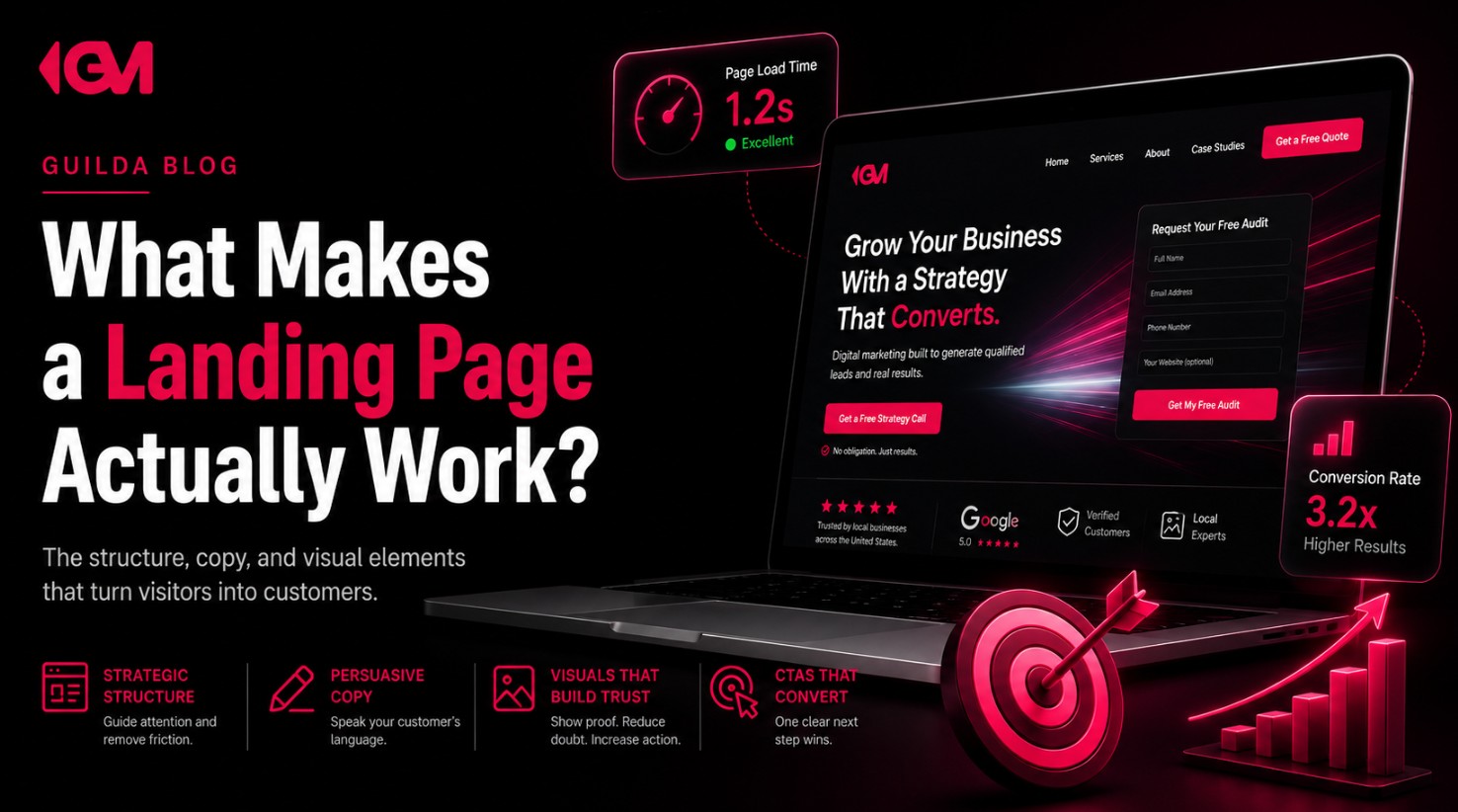
What Makes a Landing Page Actually Work for Landing Page Conversion?
A landing page works when it turns a specific visitor intent into a clear next step. Strong landing page conversion does not come from a prettier design alone. It comes from the right message, the right offer, the right trust signals, and a page structure that removes hesitation before the visitor leaves.
For many U.S. businesses, the landing page is where marketing spend either becomes opportunity or disappears quietly. A roofing company may pay for Google Ads, a SaaS company may drive traffic from LinkedIn, or an eCommerce brand may promote a seasonal product. In each case, the question is the same: does the page help the visitor decide, or does it make them work too hard?
A landing page is not just a page with a button. It is a decision environment designed around one visitor, one problem, and one clear action.
Why Landing Page Conversion Is Usually a Clarity Problem First
When a landing page underperforms, many businesses assume the problem is traffic quality, ad targeting, or design. Those can matter, but the first issue is often simpler: the page does not make the offer clear enough fast enough.
A visitor should understand three things within seconds:
- What is being offered
- Who it is for
- Why taking action now makes sense
If a visitor has to scroll, guess, compare unrelated claims, or decode vague language, conversion friction increases. The page may look polished, but it is not doing its job.
What Should the First Screen of a Landing Page Communicate?
The first screen should answer the visitor’s main question before they ask it: “Is this relevant to me?” This is especially important for paid search, local service campaigns, and high-intent traffic from Google.
A strong first screen usually includes:
- A specific headline tied to the visitor’s problem or desired outcome
- A short supporting sentence that explains the offer clearly
- One primary call to action, such as “Request a Quote” or “Schedule a Consultation”
- A trust signal, such as reviews, service area, credentials, or a recognizable client type
- A visual that supports the offer instead of distracting from it
For example, a local HVAC company sending Google Ads traffic to a generic homepage may lose visitors who were searching for emergency AC repair. A landing page built around emergency AC repair, service area coverage, fast contact options, and review-based trust has a much clearer conversion path.
Landing Page Conversion Depends on Message Match
Message match means the landing page continues the promise that brought the visitor there. If the ad, search result, email, or social post says one thing, but the page opens with something broader or unrelated, trust drops immediately.
| Traffic Source | Weak Landing Page Match | Stronger Landing Page Match |
|---|---|---|
| Google Ads for “bathroom remodeling quote” | General contractor homepage | Bathroom remodeling quote page with project examples and a clear form |
| Meta Ads for a skincare clinic offer | Services page with every treatment listed | Focused consultation page with benefits, expectations, and trust signals |
| SaaS campaign for workflow automation | Product page full of features | Use-case page showing the business problem, workflow, and demo CTA |
The stronger approach does not require hype. It requires alignment. The visitor clicked because of a specific need. The page should respect that need immediately.
Copy That Converts Is Specific, Not Loud
Good landing page copy does not try to say everything. It prioritizes what the visitor needs to believe before taking action.
That usually means answering questions like:
- What problem does this solve?
- Why is this business credible?
- What makes this offer different from other options?
- What happens after I submit the form or click the button?
- Is this worth my time, money, or contact information?
A common mistake is writing copy from the company’s perspective instead of the visitor’s decision process. “We offer high-quality solutions” says very little. “Get a clear repair estimate before replacing your entire system” is more useful because it addresses a real concern.
Strong Landing Page Copy Usually Has These Layers
- Problem clarity: Show that you understand why the visitor is there.
- Offer clarity: Explain what they get and how it works.
- Trust clarity: Reduce doubt with reviews, proof, credentials, process, or transparency.
- Action clarity: Make the next step obvious and low-friction.
The Visual Elements That Actually Support Conversion
Visual design should guide attention, not decorate the page. A landing page can look modern and still fail if the visual hierarchy is weak.
The most useful visual elements often include:
- Clear CTA buttons that stand out and use action-oriented language
- Realistic images that show the service, product, team, result, or use case
- Trust badges or credibility markers when they are relevant and legitimate
- Review snippets that address hesitation, not just praise the business
- Simple section spacing that makes the page easy to scan on mobile
Stock imagery, oversized animations, and vague icons can make a page feel generic. For a local business, photos of the team, service vehicles, completed work, clinic environment, office, or process may build more confidence than a perfect but anonymous image.
Trust Signals Are Not Optional on High-Intent Pages
A visitor who is close to taking action is also close to comparing options. That is why trust signals matter so much on landing pages for service businesses, clinics, professional firms, eCommerce stores, and SaaS companies.
Useful trust signals may include:
- Google reviews or third-party review references
- Before-and-after visuals when appropriate and compliant
- Certifications, licenses, or professional affiliations
- Clear service areas for local or service-area businesses
- Transparent process steps
- Security, return, shipping, or support details for eCommerce
- Product screenshots, integrations, or demo expectations for SaaS
The goal is not to overload the page with badges. The goal is to reduce the specific risks the visitor feels before contacting you, buying, booking, or requesting a quote.
The CTA Should Match the Visitor’s Level of Commitment
Not every visitor is ready for the same level of action. A high-intent search visitor may be ready to call. A SaaS visitor comparing tools may prefer a demo. A first-time eCommerce visitor may need sizing, shipping, or return clarity before buying.
A strong call to action is specific and realistic:
| Weak CTA | Stronger CTA | Why It Works Better |
|---|---|---|
| Submit | Request a Free Estimate | The visitor knows what they are asking for |
| Learn More | Schedule a Product Demo | The action matches a SaaS buying process |
| Contact Us | Talk to a Specialist | The CTA feels more guided and less generic |
The form should also respect the commitment level. Asking for too much information too early can reduce submissions. Asking for too little can hurt lead quality. The right balance depends on the offer, price point, urgency, and sales process.
A Diagnostic Checklist for Landing Page Conversion
Before redesigning a landing page, check whether the page answers the right questions. This simple audit can reveal why visitors hesitate.
- Does the headline clearly match the visitor’s intent?
- Can a visitor understand the offer without scrolling?
- Is there one primary CTA repeated naturally throughout the page?
- Does the page explain what happens after the visitor takes action?
- Are the trust signals specific to the visitor’s concern?
- Is the page easy to use on mobile?
- Does the form ask only for information that is useful at this stage?
- Are page speed, layout, and readability helping the visitor move forward?
- Does the page remove common objections before the CTA?
- Can calls, form submissions, bookings, or purchases be tracked properly?
If several answers are “no,” the page may not need more traffic. It may need a stronger conversion system.
What Many Businesses Get Wrong About Landing Pages
The biggest mistake is treating a landing page as a design asset instead of a sales and decision tool. A beautiful layout cannot compensate for weak positioning, vague copy, missing trust, or an offer that does not match the visitor’s intent.
Mistake 1: Sending Every Campaign to the Homepage
A homepage has to serve many audiences. A landing page should serve one. Sending paid traffic to a broad homepage often forces visitors to search for the information they expected to see immediately.
Mistake 2: Using Generic Claims Instead of Buyer-Relevant Proof
Phrases like “trusted professionals” or “quality service” are not enough by themselves. Visitors need proof that connects to their situation: reviews, examples, process clarity, transparent expectations, and specific expertise.
Mistake 3: Measuring Only Form Submissions
Form submissions matter, but they are not the whole picture. Calls, booked appointments, quote requests, purchases, demo requests, lead quality, and follow-up speed can all affect whether landing page traffic becomes real business.
How Landing Pages Connect SEO, Paid Ads, and Lead Quality
Landing pages are often discussed as a paid traffic tool, but they also influence the broader digital strategy. A strong page can support paid search, local SEO campaigns, service pages, content strategy, and sales follow-up.
For a service business, a landing page may help turn local search visibility into quote requests. For an eCommerce brand, it can improve the path from product interest to purchase. For SaaS, it can clarify use cases and reduce confusion before a demo request.
This is why conversion rate optimization should not be separated from strategy. If a business invests in Google Ads, Meta Ads, SEO, or Google Business Profile optimization but sends visitors to a weak page, the marketing system becomes harder to measure and more expensive to improve.
When a Landing Page Needs Strategic Help
It may be time to get strategic help when the page receives traffic but does not produce enough qualified actions, or when the business cannot clearly see where visitors are dropping off.
Warning signs include:
- Paid ads are generating clicks but few qualified leads
- Visitors leave quickly without interacting
- The page looks good but the offer is hard to explain
- Mobile users convert poorly
- Different campaigns are all using the same generic page
- The business cannot track which channels produce real opportunities
A stronger landing page strategy looks at the full path: traffic source, search intent, offer, copy, design, page speed, trust signals, form friction, tracking, CRM handoff, and follow-up.
FAQ About Landing Page Conversion
What is the most important part of a landing page?
The most important part is the alignment between visitor intent, offer, copy, and CTA. Design matters, but clarity is what helps visitors decide whether to act.
Why are my landing pages getting clicks but no leads?
Common causes include weak message match, unclear offers, too much form friction, missing trust signals, poor mobile experience, slow page speed, or a CTA that does not match the visitor’s readiness.
Should every paid ad campaign have its own landing page?
Not always, but each campaign should lead to a page that closely matches the visitor’s intent. A campaign for emergency services, a consultation, a product category, or a SaaS demo usually performs better with a focused page than with a generic homepage.
Do landing pages help SEO?
Some landing pages are built mainly for paid traffic and are not meant to rank organically. Others can support SEO when they provide useful, indexable content around a clear service, location, product, or use case. The right approach depends on the strategy.
How often should a landing page be improved?
A landing page should be reviewed when traffic quality changes, conversion rates drop, ad costs rise, the offer changes, or tracking shows that visitors are not taking the expected action.
Before You Spend More on Traffic, Fix the Decision Path
A working landing page does more than collect clicks. It helps the right visitor understand the offer, trust the business, and take the next step with less hesitation.
Before investing more in ads, SEO, or lead generation, look at the page where those visitors land. If the message is unclear, the CTA is weak, the proof is thin, or the mobile experience creates friction, more traffic may only amplify the problem.
Guilda Marketing helps businesses build a stronger digital presence by connecting visibility, website conversion, and lead generation strategy. If your landing pages are getting attention but not enough qualified action, it may be time to talk to Guilda Marketing about a clearer path from traffic to opportunity.
“`
Want to apply this to your business?
Tell us about your business and we will review your digital presence, growth stage and the biggest opportunities for your next marketing move.