Local SEO Strategy Competitors Ignore
The Local SEO Strategy Most Competitors Ignore The local SEO strategy most competitors ignore is not one tactic. It is the connection between your Google Business Profile, your local service pages, and your regional authority signals. Most businesses work on these separately. Stronger local competitors make them support each other. For a local business in […]
The Local SEO Strategy Most Competitors Ignore
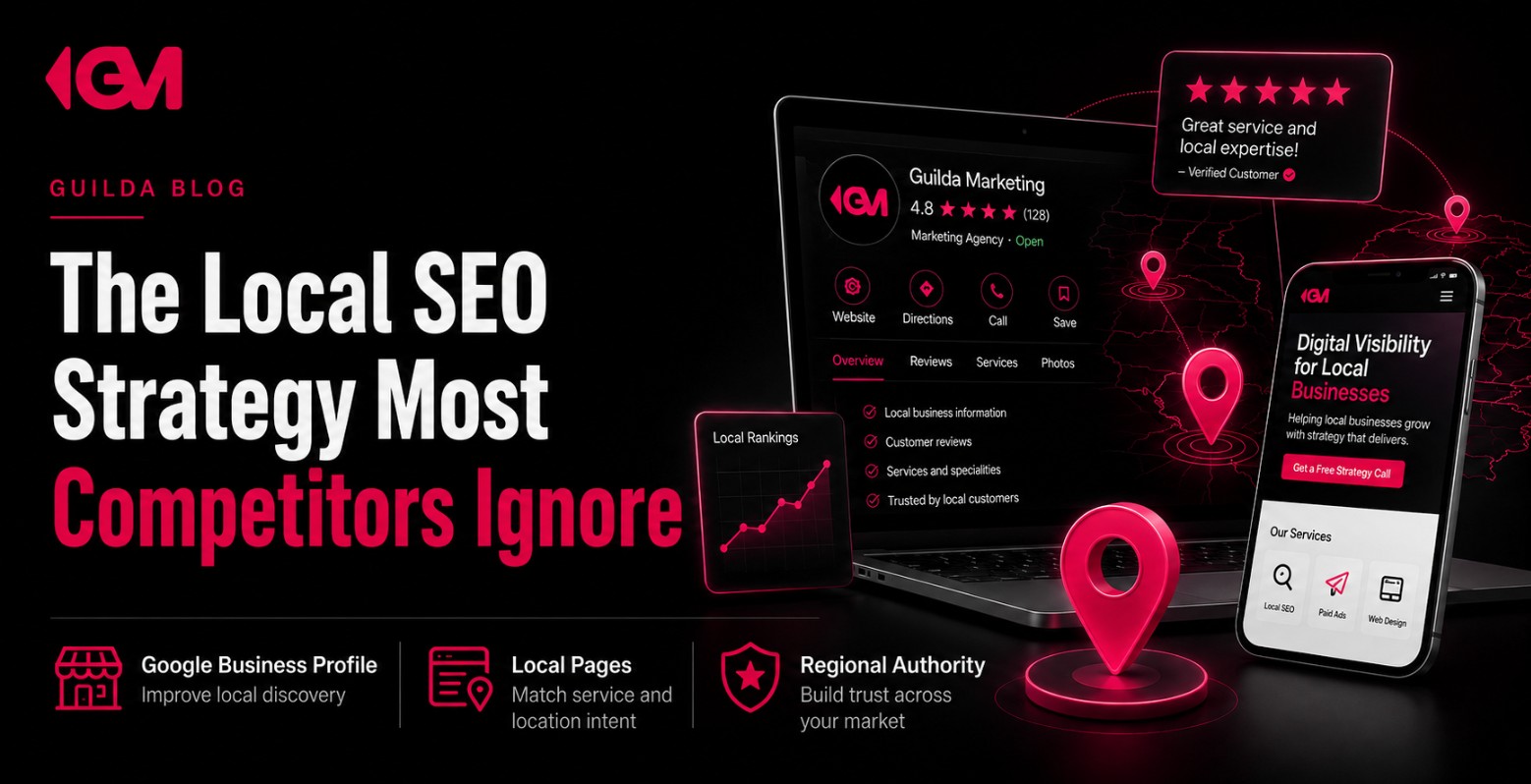
The local SEO strategy most competitors ignore is not one tactic. It is the connection between your Google Business Profile, your local service pages, and your regional authority signals. Most businesses work on these separately. Stronger local competitors make them support each other.
For a local business in the United States, this matters because customers rarely make decisions from one source alone. They may find you on Google Maps, check your reviews, open your website, compare your service page, look for proof that you serve their area, then decide whether to call or request a quote.
If those pieces are disconnected, visibility becomes fragile. Your profile may get impressions, but your website does not convert. Your service pages may exist, but they do not reinforce your local relevance. Your reviews may be positive, but they are not supported by strong location-specific content.
Local SEO does not work best as a checklist. It works best as a connected trust system.
Why Most Local SEO Strategies Stall After Profile Optimization
Many businesses treat Google Business Profile optimization as the whole strategy. They update the business name, category, hours, photos, and services, then expect local rankings and leads to improve on their own.
That is a start, not a complete growth system. Your profile can help people discover you, but it cannot carry every trust signal, every service detail, every location page, every objection, and every conversion path your website should handle.
The profile is the doorway, not the whole house
A potential customer searching for an HVAC company, dental office, remodeling contractor, law firm, med spa, or cleaning service may first see your Google Business Profile. But the decision often continues on your website.
That is where they look for answers such as:
- Do you actually provide the service I need?
- Do you serve my city, neighborhood, or service area?
- Do you look credible compared with the other businesses I opened?
- Can I quickly call, book, request a quote, or ask a question?
- Do your reviews, photos, content, and website all tell the same story?
The Local SEO Strategy Competitors Ignore: Profile, Pages, and Authority Working Together
A stronger local SEO strategy connects three layers: your Google Business Profile, your website pages, and your regional authority. When those layers are aligned, Google and customers can understand what you do, where you operate, and why your business is a trustworthy option.
| Weak Local SEO Approach | Stronger Local SEO Approach |
|---|---|
| Only filling out the Google Business Profile | Using the profile to reinforce services, locations, reviews, photos, and website conversion paths |
| One generic service page for every customer | Clear service pages built around how local customers actually search and compare options |
| City pages with thin, repeated text | Useful local pages that explain service coverage, local needs, proof, and next steps |
| Random citations and directory listings | Consistent regional authority built through relevant listings, partnerships, local mentions, and review signals |
How to Make Google Business Profile Support Your Local SEO Strategy
Your Google Business Profile should do more than exist. It should support the same positioning your website and local pages communicate.
For a local business, that means the profile should clearly reflect your real services, service area, customer experience, and trust signals. A profile that says one thing while the website says another creates friction for both search visibility and customer confidence.
Profile elements that deserve strategic attention
- Primary category: choose the category that best matches your main revenue-driving service.
- Services: describe what people actually buy, not just internal business labels.
- Photos: show real work, real space, real team members, service vehicles, products, or customer-facing details when appropriate.
- Reviews: encourage honest reviews and respond professionally, especially when customers mention specific services or locations.
- Website link: send visitors to the most useful page, not always the homepage by default.
- Business information: keep hours, phone number, address, service areas, and appointment options accurate.
What not to do with your profile
Do not turn your profile into a keyword-stuffed listing. Do not create fake locations. Do not use confusing service names just because they sound more search-friendly. Do not ignore customer questions, outdated hours, low-quality photos, or reviews that deserve a professional response.
The goal is not to manipulate the profile. The goal is to make the profile a clearer, more trustworthy entry point into your business.
Why Local Pages Matter More Than Most Businesses Realize
Local pages help connect your services to the places where customers are searching. The mistake is creating dozens of almost identical pages with only the city name changed.
A useful local page should answer the questions a buyer in that market is likely to ask. It should make the service easier to understand, prove that the business is relevant to that area, and make the next action simple.
A practical example for a U.S. service business
Imagine a roofing company serving several suburbs around Dallas, Chicago, Phoenix, or Atlanta. A weak local page says, “We offer roofing services in this city,” then repeats the same generic text across every location.
A stronger page explains what roof problems are common in that area, which services are available, what types of properties the company serves, what the estimate process looks like, what customers should prepare before calling, and why local proof matters.
That page is not just written for Google. It helps the customer feel, “This business understands my area and my situation.”
What a strong local page should include
- The specific service and location focus
- A clear explanation of who the service is for
- Local relevance without fake claims
- Service details that reduce buyer hesitation
- Trust signals such as reviews, proof points, credentials, photos, or process clarity
- A strong call to action for calls, quote requests, appointments, or consultations
Regional Authority Is the Layer Competitors Often Miss
Regional authority is the evidence around the web that your business is relevant, active, trusted, and connected to the area you serve. This can include local citations, industry directories, local partnerships, community mentions, review patterns, location-specific content, and consistent business information.
Many competitors ignore this because it is slower than editing a profile or publishing a quick page. But it is often the layer that separates a thin local SEO setup from a stronger local presence.
Regional authority can come from practical sources
- Relevant local business directories
- Chamber of commerce listings when appropriate
- Industry-specific directories for contractors, healthcare providers, attorneys, consultants, or professional services
- Local sponsorships or partnerships that naturally mention the business
- Content that answers local customer questions
- Consistent name, address, phone number, and website details across important platforms
The point is not to chase every listing available. The point is to build a clean, credible footprint that reinforces the same business identity everywhere customers and search systems may encounter it.
A Local SEO Strategy Diagnostic Checklist
Use this checklist to identify whether your local SEO is connected or fragmented.
- Does your Google Business Profile match the services you most want to sell?
- Does your profile link to a page that helps visitors take the next step?
- Do your service pages explain the offer clearly, or do they sound like generic category pages?
- Do your local pages provide real value, or are they mostly duplicated text?
- Do your reviews mention specific services, locations, staff members, or outcomes?
- Is your business information consistent across important directories and platforms?
- Does your website make calling, booking, or requesting a quote easy on mobile?
- Do you have proof that supports trust before the customer contacts you?
- Can you tell which locations, services, and pages are actually producing leads?
How to Prioritize Local SEO When Everything Looks Important
Local SEO becomes overwhelming when every issue looks equally urgent. A better approach is to prioritize based on business impact.
- Fix accuracy first: business name, phone number, address, hours, categories, and service areas should be clean and consistent.
- Strengthen the money pages: improve the pages tied to your highest-value services and locations.
- Reduce conversion friction: make calls, forms, booking options, and mobile navigation easier.
- Build trust signals: improve reviews, photos, proof, credentials, process explanations, and FAQs.
- Expand regional authority: earn relevant local mentions, directory consistency, partnerships, and helpful local content.
This sequence helps avoid a common mistake: publishing more content before fixing the pages and profile elements that already influence customer decisions.
What Local SEO Means for Paid Ads and Lead Quality
Local SEO does not replace paid search or Meta Ads. It makes the rest of your marketing work on a stronger foundation.
If someone clicks a Google Ad and lands on a weak local page, the ad spend has to work harder. If someone sees your business in Google Maps but your website lacks trust signals, reviews and profile visibility may not turn into calls. If a lead submits a form but your follow-up process is slow, the problem is no longer ranking. It is conversion and sales process.
That is why local SEO should be connected to website conversion, lead generation, CRM tracking, and follow-up. Visibility matters, but the business impact comes from turning local attention into qualified opportunities.
Common Mistakes That Keep Local Businesses Invisible
Mistake 1: Using the homepage for every local search intent
Your homepage may explain who you are, but it usually cannot answer every service and location question. Service pages and local pages help match more specific intent.
Mistake 2: Creating location pages with no useful local context
A page that only swaps one city name for another can feel thin to readers. Stronger pages explain service relevance, local considerations, proof, and next steps.
Mistake 3: Treating reviews as reputation only
Reviews also shape decision-making. When customers mention specific services, locations, responsiveness, quality, or professionalism, those details can support trust before a visitor contacts you.
Mistake 4: Ranking for the wrong services
Visibility is not valuable if it attracts the wrong inquiries. Local SEO should prioritize profitable services, realistic service areas, and leads your business can actually serve well.
When Should a Business Get Strategic Help With Local SEO?
It may be time to get strategic help when your business has traffic or profile views but inconsistent calls, weak lead quality, poor local rankings, confusing service pages, or no clear way to measure which locations and services are producing opportunities.
This is especially important for service-based businesses where each lead has real commercial value. A roofing company, law firm, dental office, remodeling contractor, med spa, therapy practice, or professional service provider cannot afford to treat local visibility as a loose collection of tasks.
A stronger strategy looks at the whole path: discovery, comparison, trust, conversion, tracking, and follow-up.
Local SEO FAQ for Business Owners
Is Google Business Profile enough for local SEO?
No. It is important, but it works best when supported by strong service pages, local content, reviews, website trust signals, and consistent business information across relevant platforms.
Do local pages still matter?
Yes, when they are useful. Local pages should not be duplicated filler. They should help customers understand services, service areas, proof, and next steps.
Can local SEO improve lead quality?
It can support better lead quality when the strategy targets the right services, locations, and search intent. Lead quality also depends on page clarity, offer positioning, forms, calls, and follow-up.
Should I work on local SEO before increasing ad spend?
Often, yes. If your website, profile, reviews, and landing pages are weak, more ad spend may simply send more visitors into the same conversion problems.
How to Build a Local Presence That Converts
The competitors who win locally are not always the ones doing the most random SEO tasks. They are often the ones with the clearest connection between what customers see on Google, what they read on the website, and what they believe about the business before contacting it.
That is the part many local businesses ignore. Google Business Profile, local pages, reviews, website conversion, and regional authority should not operate separately. They should work as one system.
If your business depends on local calls, quote requests, appointments, or service-area visibility, Guilda Marketing can help you build a clearer local business marketing strategy that connects visibility with stronger conversion paths.
Want to apply this to your business?
Tell us about your business and we will review your digital presence, growth stage and the biggest opportunities for your next marketing move.