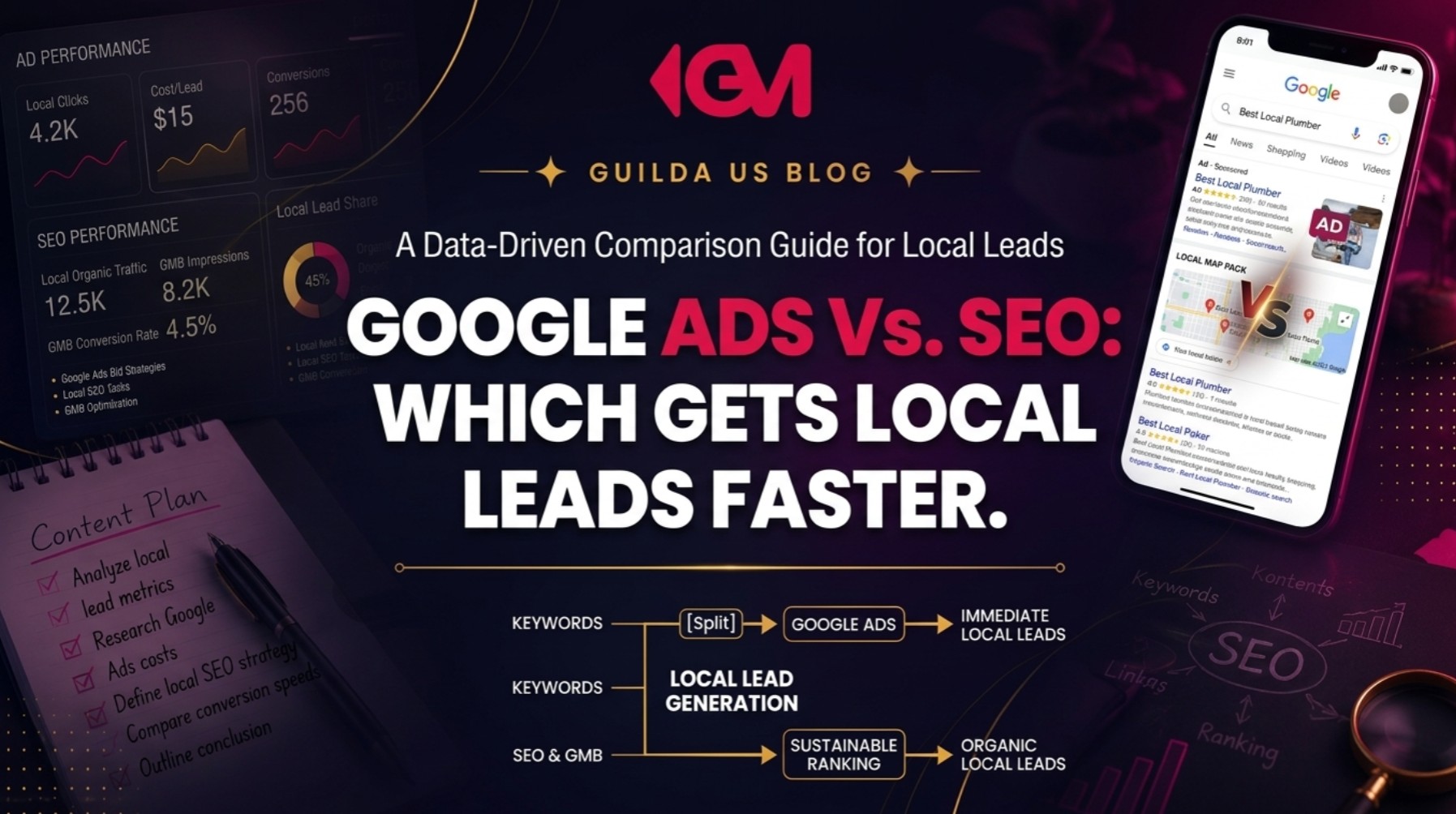
Google Ads vs. SEO: Which Gets Local Leads Faster?
“`html Google Ads vs. SEO for Local Service Businesses: Which Delivers Leads Faster? By Raphael Maio, Founder & CEO of Guilda Marketing. Google Ads will usually give a local service business its first opportunity to generate leads faster than SEO. Once an eligible campaign begins entering search auctions, the business can appear for relevant searches […]
“`html
Google Ads vs. SEO for Local Service Businesses: Which Delivers Leads Faster?
By Raphael Maio, Founder & CEO of Guilda Marketing.
Google Ads will usually give a local service business its first opportunity to generate leads faster than SEO. Once an eligible campaign begins entering search auctions, the business can appear for relevant searches without waiting for an organic page to be crawled, indexed, and ranked.
That does not mean Google Ads will automatically produce profitable jobs. A campaign can generate clicks quickly while exposing problems with targeting, landing pages, call handling, lead qualification, or follow-up.
SEO generally takes longer to influence lead volume, but it can create a more durable source of visibility that does not require paying for every visit. For many local service businesses, the strongest decision is not choosing one channel forever. It is using paid search to capture near-term demand while building organic visibility that improves the economics of lead generation over time.
Google Ads usually wins the race to visibility. SEO can win the longer race toward durable demand and lower dependence on paid traffic.
“Faster leads” can mean four different things
Business owners often compare Google Ads and SEO as if speed were a single metric. In practice, there are at least four separate questions:
- How quickly can the business appear in front of potential customers?
- How quickly can it generate its first qualified inquiry?
- How quickly can it establish a predictable cost per booked job?
- How quickly can the channel become a reliable part of the sales pipeline?
Google Ads often performs better on the first two questions. Neither channel automatically solves the final two.
| Decision factor | Google Ads | SEO |
|---|---|---|
| Initial visibility | Can begin once the campaign is eligible and competitive in the auction. | Depends on discovery, indexing, relevance, competition, and ranking. |
| Traffic control | Strong control over budget, location, schedule, keywords, and landing pages. | Less direct control over when and where Google displays a result. |
| Learning speed | Search terms, calls, forms, and conversion data can create a faster feedback loop. | Patterns usually develop more gradually as visibility and traffic increase. |
| Ongoing traffic cost | Traffic normally declines when advertising spend stops. | Existing pages may continue attracting visitors, although rankings can change. |
| Primary risk | Paying for irrelevant, unqualified, or poorly handled leads. | Investing in weak pages or content that never earns meaningful visibility. |
Why Google Ads usually wins the first-lead race
Google Ads gives a local service business a way to compete for searches that are already happening. A plumber, HVAC company, roofing contractor, attorney, cleaning company, or wellness provider can target searches connected to a specific service and location.
Eligible ads enter an auction each time a relevant search occurs. Placement is not based only on who bids the most. Google also evaluates factors connected to Ad Rank, including the quality and relevance of the ad and landing page.
This gives advertisers several advantages when speed matters:
- Location control: campaigns can focus on selected cities, ZIP codes, regions, or service areas.
- Schedule control: ads can be aligned with operating hours or periods when someone can answer calls.
- Service-level targeting: budget can be concentrated on higher-priority or higher-value services.
- Landing page control: each service can send visitors to a more relevant page instead of a generic homepage.
- Immediate demand signals: search term and conversion data can reveal which offers are attracting inquiries.
The business does not have to wait for an organic page to move through the search results before testing whether a service, location, offer, or landing page can generate demand.
Google Ads is more likely to produce leads quickly when:
- The service already has active search demand.
- The campaign targets commercially relevant searches rather than every loosely related term.
- The service area is realistic for the available budget.
- The landing page clearly explains the service, location, next step, and trust signals.
- Calls, forms, booked appointments, and qualified leads are tracked correctly.
- Someone can answer or return inquiries promptly.
- The business knows which jobs are profitable enough to support paid acquisition.
Without those foundations, paid search may generate activity without generating healthy business growth.
Why SEO takes longer, but can change the economics
SEO involves helping search engines discover, understand, index, and evaluate a website’s pages. Following SEO best practices does not guarantee that Google will crawl, index, or rank a specific page.
A local service business may need to improve several connected assets before organic search becomes a dependable source of leads:
- Service pages that match what potential customers actually need.
- Clear information about cities, neighborhoods, or service areas.
- A complete and credible Google Business Profile.
- Consistent business information across important online properties.
- Customer reviews and a responsible review-generation process.
- Strong website structure, internal linking, mobile usability, and page speed.
- Helpful content that addresses real questions without creating thin location or keyword pages.
- Authority and trust signals that support both rankings and conversions.
This work takes longer because the business is not simply purchasing access to an auction. It is building a collection of assets that must be useful to customers and understandable to search engines.
The advantage is that a useful service page can support organic search, paid advertising, sales conversations, customer education, and conversion optimization at the same time.
SEO is not just publishing blog posts
A common mistake is treating SEO as a monthly article quota. A company publishes broad posts such as “Why Maintenance Is Important” while its core service pages remain thin, confusing, or nearly identical.
For a local service business, the highest-priority organic opportunities are often much closer to the sale:
- Can Google understand the exact services offered?
- Can a customer confirm that the company serves their location?
- Does each important service have a useful page?
- Does the website demonstrate experience and credibility?
- Can visitors quickly call, request a quote, or book an appointment?
Publishing more content does not compensate for weak commercial pages or an unconvincing local presence.
The hidden reason paid leads can look fast but still fail
Google Ads can create traffic quickly, which means it can also reveal operational weaknesses quickly.
Consider a hypothetical HVAC company that begins advertising emergency repair services. The campaign generates calls, but the company concludes that the leads are poor because few become booked jobs.
A closer review might reveal that:
- Several calls went unanswered.
- Voicemails were returned the following day.
- The landing page did not explain the service area.
- The campaign attracted searches for jobs, parts, and do-it-yourself repairs.
- The team counted every call as a lead, even when the caller was outside the service area.
- No one connected advertising data to scheduled appointments or completed jobs.
In that situation, the channel is only part of the problem. The business has a measurement, qualification, and follow-up problem.
Audit the conversion path before increasing the budget
- Search: Is the business appearing for the right service and location?
- Click: Does the ad set an accurate expectation?
- Landing page: Does the page build trust and make the next step obvious?
- Contact: Is the form simple, and is the phone number easy to use on mobile?
- Response: How quickly does someone answer or follow up?
- Qualification: Is the inquiry relevant, serviceable, and commercially valuable?
- Outcome: Did the lead become an appointment, estimate, sale, or completed job?
Optimizing only for form submissions can push a campaign toward more inquiries without improving revenue. Local service companies should measure deeper outcomes whenever their systems and lead volume make that possible.
Choose the channel based on the business situation
| Business situation | Recommended priority | Reason |
|---|---|---|
| A new business needs inquiries soon | Controlled Google Ads test, with foundational SEO in parallel | Ads can test demand before the website has meaningful organic visibility. |
| An established company depends almost entirely on ads | Increase SEO investment without abruptly stopping profitable campaigns | Organic visibility can reduce long-term dependence on one paid channel. |
| The website converts poorly | Fix landing pages, tracking, trust, and contact paths first | Sending more paid or organic traffic to a weak experience increases waste. |
| The business has seasonal capacity to fill | Google Ads for immediate control, SEO for future seasonal demand | Paid campaigns can be adjusted faster around capacity and timing. |
| The business dominates one service but wants to enter another | Use ads to validate the new service while developing its organic assets | Paid data can inform messaging, targeting, and page development. |
| The company cannot identify which leads become customers | Measurement and CRM cleanup before scaling either channel | Traffic growth is difficult to evaluate without business outcome data. |
A practical 90-day combined approach
A 90-day plan should not promise organic rankings. Its purpose is to create a stronger measurement system, test immediate demand, and build the assets required for longer-term visibility.
Days 1 to 30: Fix measurement and conversion readiness
- Define what counts as a qualified lead.
- Track calls, forms, appointments, and other meaningful actions.
- Review mobile usability and the contact process.
- Create or improve the landing page for the priority service.
- Confirm service areas, hours, offers, and response responsibilities.
- Review the Google Business Profile and core business information.
- Launch a tightly scoped paid campaign if the business is ready to handle demand.
Days 31 to 60: Improve lead quality and organic foundations
- Review paid search terms and exclude irrelevant patterns.
- Compare calls and forms with actual qualified opportunities.
- Strengthen the highest-value service pages.
- Improve internal links, titles, headings, and local relevance.
- Address duplicate, weak, or confusing location content.
- Build a consistent process for requesting legitimate customer reviews.
Days 61 to 90: Reallocate effort based on evidence
- Increase paid investment only where lead quality and economics support it.
- Pause or revise services that attract activity without valuable outcomes.
- Use real customer questions to guide useful content.
- Develop additional service pages only when they represent distinct customer needs.
- Compare channels using booked jobs and revenue, not traffic alone.
This sequence allows paid search to provide faster market feedback while the SEO program improves the website and local presence.
Measure booked opportunities, not marketing activity
The wrong scorecard can make either channel appear more successful than it is.
Useful Google Ads measurements
- Qualified calls and form submissions.
- Cost per qualified lead.
- Cost per booked appointment or estimate.
- Lead-to-booking rate.
- Close rate by campaign or service.
- Search terms producing valuable and irrelevant inquiries.
- Missed-call and follow-up performance.
Useful SEO measurements
- Organic inquiries from relevant service pages.
- Non-branded visibility for priority services and locations.
- Google Business Profile calls, website visits, and direction requests.
- Organic landing page conversion rates.
- Qualified leads and booked work attributed to organic search.
- Growth in the number of commercially useful pages earning visibility.
Rankings, impressions, clicks, and website sessions are diagnostic metrics. The business outcome is a qualified opportunity that can become profitable work.
So, should a local service business start with Google Ads or SEO?
Start with Google Ads when the business needs faster market visibility, has enough budget to test responsibly, and can track and handle incoming leads.
Prioritize SEO foundations when the website is unclear, service pages are weak, local information is inconsistent, or the company is overly dependent on paid traffic.
For many companies, the most commercially sensible sequence is:
- Fix tracking, landing pages, and lead handling.
- Use a controlled Google Ads campaign to capture and test active demand.
- Build SEO and local visibility in parallel.
- Evaluate both channels using qualified leads, booked jobs, and revenue.
- Shift budget based on evidence rather than channel loyalty.
Google Ads and SEO are not opposing systems. Paid search can identify valuable queries, services, locations, and landing page weaknesses. SEO can turn those lessons into stronger long-term assets. Conversion optimization and lead tracking connect both channels to actual business performance.
Build a lead generation system, not two disconnected campaigns
The fastest channel is not always the channel that creates the healthiest growth. A local service business needs visibility, but it also needs relevant targeting, persuasive pages, accurate tracking, responsive follow-up, and a clear understanding of which inquiries become customers.
Guilda Marketing helps service companies connect paid traffic, SEO, landing pages, conversion strategy, and lead measurement into a clearer growth system. Learn more about our approach to digital marketing for service providers.
Sources and Further Reading
- Google Ads Help: How the Google Ads Auction Works
- Google Ads Help: About Ad Rank
- Google Ads Help: Phone Call Conversion Tracking
- Google Search Central: How Google Search Works
- Google Search Central: SEO Starter Guide

ABOUT THE AUTHOR
Raphael Maio, Founder & CEO of Guilda Marketing
Raphael Maio is the Founder and CEO of Guilda Marketing and a digital marketing strategist with nearly a decade of experience in SEO, paid media, website strategy, conversion optimization, and lead generation. He helps businesses build clearer, more measurable digital growth systems.
“`
Want to apply this to your business?
Tell us about your business and we will review your digital presence, growth stage and the biggest opportunities for your next marketing move.