
Why Your Real Estate Business Shouldn’t Depend on Zillow
Your Real Estate Business Shouldn’t Depend Entirely on Zillow Zillow can be useful. Buyers use major property portals, agents can receive connections through them, and listings distributed to large marketplaces can put inventory in front of people who are actively searching. The problem starts when a real estate business confuses access to an audience with […]
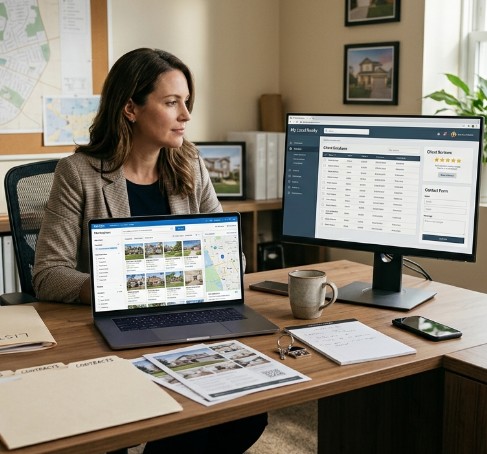
Your Real Estate Business Shouldn’t Depend Entirely on Zillow
Zillow can be useful. Buyers use major property portals, agents can receive connections through them, and listings distributed to large marketplaces can put inventory in front of people who are actively searching. The problem starts when a real estate business confuses access to an audience with ownership of that audience.
If most of your visibility, inquiries, and online credibility depend on one third-party platform, your pipeline is being built on infrastructure you do not control. A stronger model uses platforms such as Zillow as one channel while building direct assets around your own name, website, local visibility, content, reviews, database, and follow-up process.
Use marketplaces to reach demand. Build your own digital presence so your business does not disappear when the marketplace is no longer part of the journey.
Zillow is a channel, not your marketing foundation
A property marketplace solves an important problem: it aggregates inventory and attracts people who want to browse homes. That makes it valuable. It does not mean the marketplace should become the center of your brand.
Zillow itself describes several lead types for agents, including live connections, tour connections, and leads from consumers who select a specific agent. That is a useful acquisition environment, but the relationship begins inside another company’s ecosystem. Your own website, email database, CRM, reviews, local content, and branded search presence play a different role: they help people discover, evaluate, remember, and return to your business directly.
This distinction matters even if Zillow is currently producing good opportunities. Diversification is not an argument to abandon a channel that works. It is a way to reduce how much of your future depends on a channel you cannot fully control.
The agent still matters more than the listing portal
The growth of online home search did not eliminate the role of the real estate professional. The National Association of REALTORS reported in its 2025 Profile of Home Buyers and Sellers that 88% of buyers purchased through an agent or broker, while 91% of sellers used an agent.
That is an important marketing lesson. Consumers may discover properties through large portals, but the professional relationship still carries enormous value. Buyers want help with negotiation, understanding the process, evaluating properties, and navigating the market. Sellers want help marketing the home, pricing it competitively, and completing the sale.
Your digital presence should therefore sell more than access to listings. It should make your judgment, local knowledge, process, reputation, and service easier to understand.
What you lose when the portal becomes the brand
1. Differentiation
Inside a marketplace, agents are compared in an environment designed around property search. Your years in a neighborhood, negotiation approach, communication style, specialties, process, client stories, and market knowledge have limited room to breathe.
Your own website can explain why a seller in your market should choose you, what first-time buyers should expect, which neighborhoods you understand deeply, and how your team handles a transaction from first conversation through closing.
2. Direct discovery
Someone searching for an agent, a neighborhood guide, a home valuation resource, or an answer to a local real estate question may never begin on a listing portal. If your website has little useful content and your local presence is weak, you give up opportunities to be discovered before the prospect enters a marketplace.
3. The referral validation step
A referral is not always the end of the decision. A prospective client may hear your name from a friend and then search for you. What they find can reinforce the recommendation or create doubt.
A current website, consistent contact information, credible reviews, useful local expertise, clear services, and a professional profile give the referral somewhere to land.
4. Audience ownership
A lead that enters your CRM with appropriate consent, a past client in your database, a subscriber to a useful local market update, or a visitor who returns directly to your site creates a relationship your business can continue to develop. That is fundamentally different from repeatedly paying or depending on another platform to create the next introduction.
What a healthier real estate marketing mix looks like
| Asset or channel | Primary role | What you control |
|---|---|---|
| Zillow and property portals | Reach active property shoppers | Limited platform presence and participation |
| Your website | Explain services, expertise, markets, proof, and next steps | Content, structure, conversion path, positioning |
| Local search presence | Help prospects find and verify the business locally | Business information, content, legitimate review process, website quality |
| CRM and email | Nurture relationships and stay relevant | Segmentation, follow-up, messaging, cadence |
| Social media | Build familiarity and distribute expertise | Content, while distribution remains platform-dependent |
| Paid search and paid social | Create incremental demand and capture intent | Offer, landing page, targeting inputs, budget, measurement |
The goal is not to make every channel equal. It is to prevent one source from becoming the entire system.
Build the assets that make people search for you by name
A strong real estate brand creates reasons for a prospect to move from browsing properties to evaluating the professional behind the transaction. Start with assets that answer the questions people have before they contact you.
- Clear buyer and seller service pages instead of a generic homepage.
- Useful neighborhood and market pages based on genuine local knowledge.
- Agent or team pages that explain experience, specialties, and working style without inflated claims.
- Real client reviews presented accurately and in accordance with applicable rules.
- Case studies or transaction stories that protect client privacy and avoid unsupported promises.
- Simple calls to action for consultations, property questions, or valuation conversations.
- A CRM process that records where inquiries came from and what happened next.
- Consistent follow-up for leads, past clients, and referral relationships.
These assets compound. A useful neighborhood guide can support search visibility, become a social post, answer a prospect’s question, strengthen an email follow-up, and give a referred client another reason to trust you.
Do not replace one dependency with another
Moving all your effort from Zillow to Instagram is not diversification. Neither is relying entirely on Google Ads, referrals, or one lead vendor. Every channel has constraints. Search rankings change. Ad costs move. Social reach fluctuates. Referral volume is uneven.
The durable part is the system connecting those channels: a recognizable brand, a useful website, accurate measurement, strong follow-up, a real database, and proof that makes the next prospect more comfortable contacting you.
A practical 30-day starting point
- List every lead source from the last 90 days and identify how much depends on third-party platforms.
- Search your own name, brokerage name, and core local services. Review what a referred prospect sees.
- Fix the website’s highest-friction pages: homepage, agent or team page, buyer page, seller page, and contact path.
- Choose three local questions clients repeatedly ask and publish genuinely useful answers.
- Make sure every inquiry source is captured in your CRM or reporting process.
- Create a follow-up path for prospects who are not ready to transact immediately.
- Continue using Zillow or other portals when they produce value, but measure them as channels rather than treating them as the business’s entire marketing engine.
The goal is leverage, not independence from every platform
Real estate will always involve ecosystems you do not own: MLS systems, search engines, social networks, advertising platforms, portals, and referral networks. The goal is not to operate without them. The goal is to make sure your business becomes more valuable as those channels send attention your way.
If your real estate business is established but its digital presence depends too heavily on third-party platforms, Guilda Marketing can help identify where direct visibility, website conversion, local search, content, paid acquisition, and follow-up infrastructure need to improve. Email Raphael Maio or visit Guilda Marketing to discuss the highest-impact gaps first.
Sources and Further Reading
Want to apply this to your business?
Tell us about your business and we will review your digital presence, growth stage and the biggest opportunities for your next marketing move.
